Risk Management
The maths of staying alive. Percentage at risk, reward-to-risk, invalidation, position sizing, and how leverage actually works (and how to stop confusing it with risk).
Five video modules. Two hours total. Risk management, price action, execution, psychology, style. The framework real crypto traders use, taught from scratch. Yours free.
Most “free” trading content online is somebody yelling “BUY!” over a candle that already moved. The chart looks obvious in hindsight. The lesson never shows up.
The alternative is a paid course that promises six figures by next quarter, gated behind a sales funnel and a Discord with 4,000 emojis in the welcome message.
Neither of those teaches you a framework. They sell hype or they sell hope. So you stitch together half-lessons from Twitter threads, you read a chapter of a book, you watch ten YouTubers, and you still walk to the chart and click buy because the candle looks green. That isn’t a strategy. It’s a guess wearing a hat.
You don’t need more content. You need one structured framework taught from start to finish.
Each module builds on the one before it. Risk management is the maths that keeps you in the game long enough for the chart-reading to matter. Price action is how you read the chart. Execution is how the read becomes a placed trade. Psychology is how you actually follow your plan when fear and FOMO are screaming at you. And style is how you choose the version of trading that fits your life, instead of bending your life around a strategy that was never going to work for you.
By module five, you’ve gone from “I’ll just put 10% on this with 10x leverage” to “Account times risk percentage divided by stop distance is my position size, my stop goes where the idea is invalidated, and my reward-to-risk needs to clear 2:1 before I click.”
You can watch the modules in order, at your own pace, in your inbox. No deadlines. No live calls. No upsells inside the course.
The maths of staying alive. Percentage at risk, reward-to-risk, invalidation, position sizing, and how leverage actually works (and how to stop confusing it with risk).
A full price action framework: support and resistance, the SR flip, liquidity above swing highs and below swing lows, order blocks, breakers, fair value gaps, and how to stack multiple time frames into one trade idea.
Market versus limit. Low-time-frame entries that turn a 1.25R trade into a 7R trade. Monitoring on the right time frame. When to move a stop to break-even (and when that’s the move that taps you out of every winner). Three exit modes.
Fear and greed. FOMO. Revenge trading. Boredom. The trading plan that keeps emotion out of execution. The trade journal that turns trading from a vibe into a measurable process.
Position, swing, day, scalp. The reward-to-risk maths behind each. The five questions that pick your style for you: time commitment, trade duration, frequency, personality, and current market conditions.
Before you give us your email, here’s what the course actually is. Mayne breaks down each of the five modules, the order they go in, and what changes once you’ve watched them. No teaser. No hype reel. Just the course described by the person who built it.
2.5-minute course intro. The full course is five modules, roughly two hours of video, free.
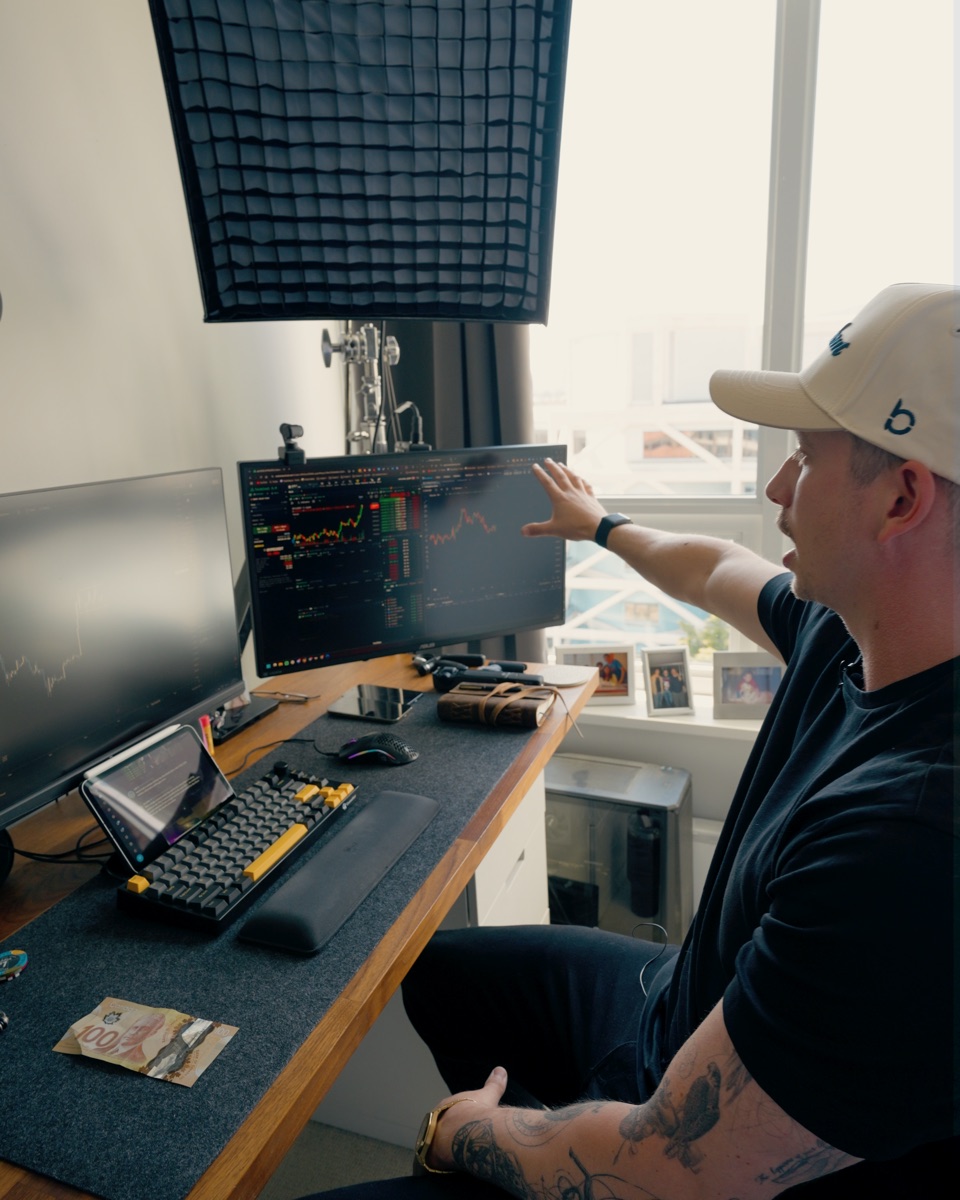
Mayne is Breakout’s cofounder and lead trader. He’s been trading crypto since 2013. He runs the kind of book you’d expect a professional crypto trader to run — swing trades on the daily and weekly, executed on lower time frames, sized to a fixed risk model. The course is the framework he uses on a normal trading day, taught from scratch.
There’s no influencer arc. No “from broke to a million dollars” story. The course doesn’t try to sell you on Mayne or on Breakout. It teaches you the framework and leaves you to use it however you want.
You won’t be a finished trader. You will be a trader with a framework. That’s the difference.
Two hours of video. Five modules. A framework you can use the next time you open a chart. Yours, free.
Breakout’s evaluation program is intentionally rigorous and designed to verify a trader’s risk-management skill and strategy discipline before any proprietary capital is allocated. Most applicants do not pass on their first attempt and there is no guarantee that your performance will improve or that you will pass any future evaluations. Prospective traders should purchase an evaluation only if they are confident in their trading ability and accept the risk of not qualifying for a funded account. Evaluation fees are non-refundable for each attempt once trading begins, regardless of outcome.
If you pass the evaluation phase and become a funded trader (“FT”) with POL, all market-facing transactions, if any, are carried out exclusively by POL, for POL’s own principal account and at its sole discretion. FTs do not own any trading account or position, and hold no beneficial or proprietary interest in POL’s accounts, assets or trades. When an FT submits a trade idea, POL may, in its absolute discretion, either (i) record the idea as an internal, administrative book entry and calculate a hypothetical result without routing any order externally, or (ii) accept the idea for POL’s proprietary book and route the transaction to a market maker or exchange. FTs have no control over, or visibility into, the method POL selects.
POL may receive financial incentives from third parties based on trade ideas provided by FTs. Any such revenue is retained solely by POL and is not shared with FTs. Because such financial incentives are not included in PnL for FTs, conflicts of interest may exist between POL and each FT. FTs should carefully consider these conflicts before participating. In addition, because Breakout earns fees each time an evaluation trader fails and then re-purchases an evaluation, conflicts of interest may also exist between Breakout and each evaluation trader.